The squash grip is an essential component of every player’s technique that should be worked on from the very first moment that a player picks up a racket.
A correct grip will give you the ability to move quickly between forehand and backhand, generate power, impart spin on the ball, control the weight of shot and hit the ball effectively to every part of the court.
In this video, SquashSkills coach Jesse Engelbrecht talks through the correct grip position for holding a squash racket.
How To Hold A Squash Racket
The squash finger grip differs from a tennis grip in that it is neither a flat, tight or uses the whole hand grip on the racket. It requires the racket to be largely held & controlled by your thumb & forefinger with the remaining three fingers supporting the racket grip, as the butt of the racket rests in your hand.

The butt of the racket should sit on the fleshy part of of your hand below your little finger. As you hold the racket, the bottom point of the V should be aligned with the inside line of the racket’s neck so that your hand sits slightly over the top of the grip.
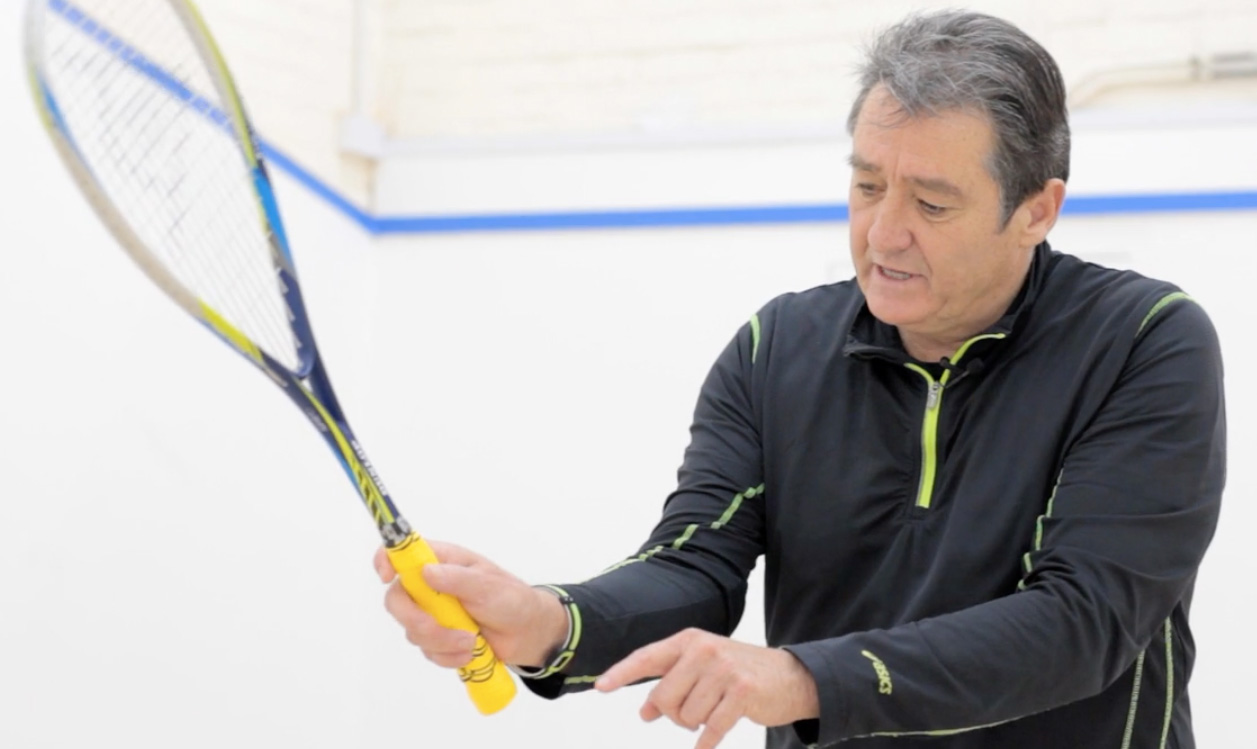
The Trigger Finger
As you grip the racket, your index finger should sit slightly away from your three supporting fingers, poised almost as if to pull a trigger. This will give you increased control of the racket head, and will prevent you from ‘clubbing’ the ball, which can be a common fault amongst amateur players.
Don’t Grip Too Tightly
Try to avoid gripping the racket too tightly, stay relaxed and firm the grip up as you start the swing. The harder you hit the ball, the firmer your grip will become. If you are looking to hit a ‘soft’ shot, you’ll generally use ‘soft hands’.

Adapting Your Squash Grip – With Lee Drew
A solid basic squash grip is the starting point. In his grip series, Lee Drew‘s argument is that it also has to adapt, because a grip that can’t change puts a ceiling on how you play. Get it wrong early and, in Lee’s words, “there’ll always be a limiter to what you can actually achieve”.
Where your hand sits on the handle is partly personal. Lee holds the racket around the middle of the grip: higher up gives more control of the racket head, lower down gives a loopier, more powerful swing, and the middle lets him move either way.
Relaxed, Then Squeeze
Gripping hard for a whole match tires your hand and stops you flowing into your shots. Lee points out that the best players are relaxed around the middle of the court, then squeeze the grip slightly as they speed the racket head up into contact.
How much depends on the shot. Drives, kills and the trickle boast get a little more squeeze. Drops and lobs stay softer, so you can feel the cut and the shape of the ball through your fingers.
Keep The Racket Face Open
The grip has to let you open the racket face on both the forehand and the backhand, because that’s where your control comes from. With a closed face at full stretch, it’s hard to get the ball above the tin or give it any height.
In defence, an open face lets you lift the ball up and over your opponent. In attack, it lets you cut down the back of the ball into the front corners, make it die and fade away, and run it tight down the sidewall.
Lee’s quick check: look at your strings. If they’ve started to shift in one direction, you’re using them to shape the ball.
When To Go Flatter
An open face isn’t the whole story. Lee points to Marwan ElShorbagy, who hits a lot of his forehands with a slightly flatter racket face to pin opponents in the back corners, and James Willstrop, who goes flatter on his forehand at times.
There are two moments for it. When the ball sits up with some height, flatten down on it and kill it so it bounces twice. Jonah Barrington drilled this into Lee at junior national squads, especially on the forehand.
And when you take the ball early as a half volley, use a compact swing and present as much of the racket face as you can, hitting through the line.
Back Corners, Full Stretch And The Sidewall
When your opponent pins the ball tight in a back corner, there’s no room for a full swing. Lee moves his hand up the grip and plays a compact, mini version of his swing, with the wrist and hand doing the work. On the backhand, he opens the face a little more to chip the ball out.
At full stretch, it’s the opposite: let the racket slide down the grip for a little extra reach. Lee is honest about why he used it: “I probably had to do this quite often because I wasn’t very quick on a squash court.” It’s often enough to pop in a drop or lift the ball out of trouble.
The ball clinging to the sidewall needs the reverse of your instinct. Most players tense up and swipe at it, which leaves it to luck. Lee’s advice is to soften your hands, think like an artist or a surgeon making a precise cut, and guide the ball back down the wall.
If you grip the racket correctly, you’ll open up a whole range of shot options that would simply not be there with an incorrect grip. Take the time to work on a neutral grip so that you can quickly move between hitting forehand and backhand shots with ease.
Jethro Binns – SquashSkills founder
Read next: Transform Your Forehand With Jethro Binns and How Often To Restring A Squash Racket.
Want To Really Master Your Grip?
Lee Drew’s grip series: 11 short videos on the basic grip, tension, the wrist, open and flat racket faces, top spin, moving up and down the grip and soft hands, plus a solo practice to groove it all. 39 minutes in total.
Watch The Series