Hitting into open space isn’t about hunting for winners. For Laura Massaro, it’s about building rallies so the court feels small for you and absolutely massive for your opponent.
In her playlist on hitting into open space, the former World No.1 breaks that down into a handful of simple shot combinations. None of them need a magic short game. Laura’s own, by her account, was never her biggest strength.
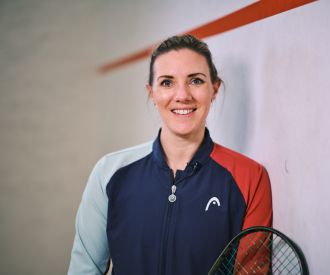 The Court Is Bigger Than It Looks
Everyone has played the match where the court feels tiny. Everyone has also played the one where it feels enormous, and you’re the one doing all the running.
Laura’s aim is to put her opponent in that second match. That means combining shots so they have to sprint the diagonal, from the furthest back corner to the furthest front corner, again and again. It’s the accumulated work across a match that wears them down, not any single rally.
Hitting Into Open Space Starts With Length
As a self-described traditional English player, Laura opens up the front of the court by hitting the back corners first, then following up short: a perfect drive, then a simple drop.
She points to Ramy Ashour. Everyone talks about his touch, his counter drops and his cross-court nicks from anywhere. Laura thinks his length is massively underestimated, and it’s what gives him access to the front.
After an exhibition match, James Willstrop came off court saying Ramy’s length had been so deep that his nose had nearly touched the back wall. From there, the drop shot is the easy part.
Once the back is open, the follow-up can be whatever your skills allow: a straight drop, a hold, a flick cross-court, a trickle boast. The length does the hard work.
Go Short To Open The Back
Then flip it. If you’re locked in a length battle with an attritional player, the front of the court is still there. You just have to go and get it.
Laura’s way in is to get up on the T, look for the volley and sit the ball in short. She isn’t looking for winners there, only a ball your opponent has to defend from the front.
Length on its own has a limit. If you never go short, your opponent’s T position drifts back, they stop covering the front, and only a dying length will win you points.
Put balls in short and they have to come up and stay honest on the T. Now the back opens up, and they’re covering the diagonal from the front corner to the far back corner. Laura calls that one of the hardest movements for any player on tour.
The Boast, Laura’s Favourite Way In
The forehand boast is one of her favourite shots, partly because she’s more comfortable going short off the side wall than directly onto the front wall. In an ideal world she’d play straight drops from everywhere, and she admits the straight drop is sometimes the better option.
But on a hot, bouncy court, or when you’re feeling nervous or edgy, the boast is a reliable way to drag your opponent forward and open up the back.
The two-wall boast pulls them up slowly. They think it’s going round, realise it isn’t, and have to make a sudden move. The three-wall boast is especially useful on a hot court where it’s hard to finish the ball: whip it round, roll it out of the nick and make them lift.
Laura’s extra layer is disguise. Shape up as if you’re playing a straight drive, then play the boast at the last minute.
Use The Height
Laura also wants you to think of the court in 3D, not 2D, because there’s a lot of space up high, especially on a court with a high ceiling.
When your opponent is firing the ball short or pinning you deep, the lob resets the rally. Get it over them and out of their attacking reach, and you buy yourself time and clarity. It’s defence that turns into attack.
Anyone who has played a good drop-lobber knows how hard it is to attack a high ball, particularly on the backhand. It also breaks up a rally where everything is at volley height, cut-line height and the same pace.
The Sixth Corner Drop
The boast works, but most matches need more than that. At some point you’ll want to go short directly onto the front wall.
That has been hard for Laura. Her short game, she says, was probably never one of her biggest strengths, and she worries far more about hitting the tin than about being counter-attacked. Her answer, worked on over her career with her coach David Pearson, is the sixth corner.
Aiming there lets you go significantly higher on the front wall while still running the ball into the side wall, low and away from your opponent. Get it right and there’s very little they can do.
A slow touch drop is the less risky version, and it’s a useful variation on the two-wall boast you’ll probably lean on most of the time.
When It Gets Messy, Keep It Simple
Strip it all back and hitting into open space is simply hitting the ball where your opponent isn’t. It’s also the first thing to go when the mist comes down in a heavy match and your game plan disappears.
Laura’s example comes from the World Team Championships in France. Sarah-Jane Perry was 2-all against an aggressive, hard-hitting young American nobody in the England camp knew much about. Playing for England, Laura says, carries more pressure than playing for yourself, and Sarah-Jane had got into a frantic, muddled state.
Between games, Laura went over with one message. You’re at your best when you move the ball around the court. Go on and hit the space.
In the next few rallies, she did. A rolled boast to open up the front, then the back, which had closed because her opponent was sitting so deep that length had stopped working.
Try It In Your Next Match
Pick one combination and commit to it. Stuck in a length battle? Put one ball short from the T and watch where your opponent’s T position goes. Front of the court open? Hit the back corner first and let the drop do the rest.
For more on building a game plan, read Improving Your Squash Tactics From The Ground Up and Tactics To Win Matches With Joel Makin.
Then ask yourself Laura’s question every rally: where isn’t your opponent?
Watch The Full Series
Seven short coaching videos with Laura: length to open the front, short shots to open the back, the boast, the lob, the sixth corner drop and keeping it simple, plus PSA match examples of her hitting open space. The full series runs under 15 minutes.
Watch The Series